Most companies don't have a traffic problem. They have an intent problem. Here's how high-intent SEO strategy drives real revenue for SaaS, IT, Mining, and B2B businesses.
SEO Isn't Content. It's Control.

Most companies don't have a traffic problem.
They have an intent problem.
They chase:
- High search volume
- Vanity metrics
- Broad keywords
But miss the only thing that matters: Buyer intent.
Because not all traffic is equal. And in 2026, that gap is widening fast.
The shift most businesses haven't caught onto
Search has changed.
- AI answers informational queries instantly
- Buyers research across multiple platforms
- Decision-making happens before they click
What still drives revenue? High-intent searches.
Keywords like:
- "CRM software pricing for enterprise"
- "mining equipment supplier Australia quote"
- "IT managed services company Perth"
- "SaaS onboarding platform demo"
- "cybersecurity services cost for business"
These are not casual searches. They are decision-stage signals. And they convert at a significantly higher rate because the user is already close to action.
SEO is not about content
Let's be clear. SEO is not:
- Writing blogs
- Posting articles
- Filling a content calendar
That's output. Real SEO is:
- Structuring your site around commercial intent
- Mapping keywords to buying stages
- Building authority in high-value categories
It's not content creation. It's demand capture infrastructure.
What high-performing companies actually target
They don't ask: "What gets the most traffic?"
They ask: "What do our best customers search before they buy?"
SaaS & Tech Examples (High Intent)
- "best CRM for real estate teams pricing"
- "HubSpot vs Salesforce comparison"
- "customer data platform demo request"
- "email marketing software for ecommerce trial"
These users are evaluating, comparing, or ready to trial — not browsing.
IT Services Examples
- "managed IT services Perth pricing"
- "cybersecurity audit company near me"
- "cloud migration services cost Australia"
- "IT support contract for small business"
Mining & Industrial Examples
- "mining equipment suppliers Western Australia"
- "bulk earthworks contractor quote"
- "drilling services company Australia"
- "fuel supply contract mining operations"
What these all have in common:
- Clear problem
- Clear solution
- Clear intent to act
This is where revenue lives.
The model: intent over volume
High-intent keywords:
- Lower volume
- Higher conversion
- Shorter sales cycle
Low-intent keywords:
- Higher volume
- Lower conversion
- Longer nurturing required
This is why focusing purely on traffic is one of the most expensive mistakes in SEO. A keyword is not valuable because it gets searched. It's valuable because the right person searches it at the right time.
Where Paid Ads fit into this (and why they matter)
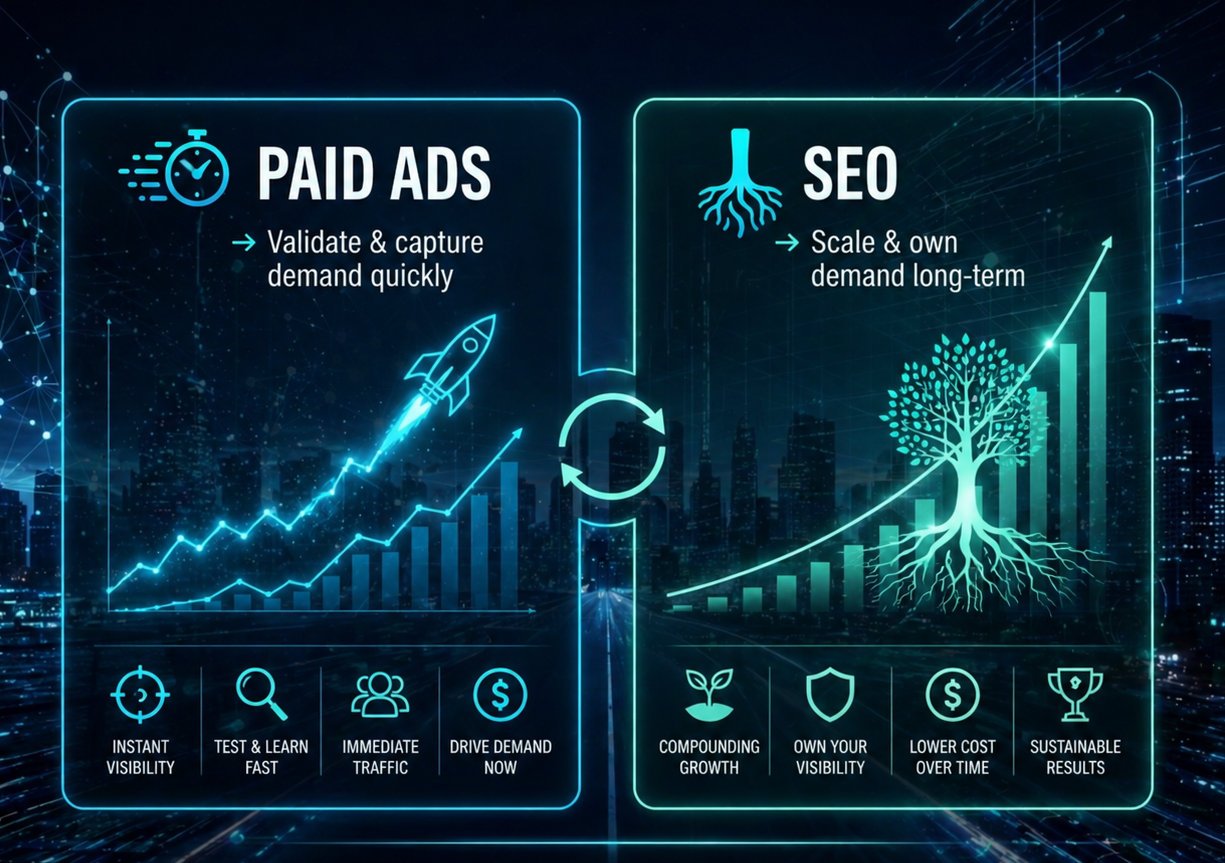
This is where most people get it wrong. SEO vs Paid Ads is not a debate. It's a system.
Paid Ads = Speed
- Immediate visibility
- Rapid testing of keywords
- Demand generation
- Data collection
SEO = Control
- Compounding visibility
- Lower long-term acquisition cost
- Ownership of high-intent search
- Sustainable pipeline
Together:
PAID ADS → Validate & capture demand quickly
SEO → Scale & own demand long-term
The smartest companies do this:
- Run paid campaigns on high-intent keywords
- Identify what converts
- Build SEO assets around those terms
- Gradually reduce cost per acquisition
Paid ads don't replace SEO. SEO doesn't replace ads. They strengthen each other.
The real SEO strategy (what actually works)
Top-performing companies build search ecosystems, not pages.
The model:
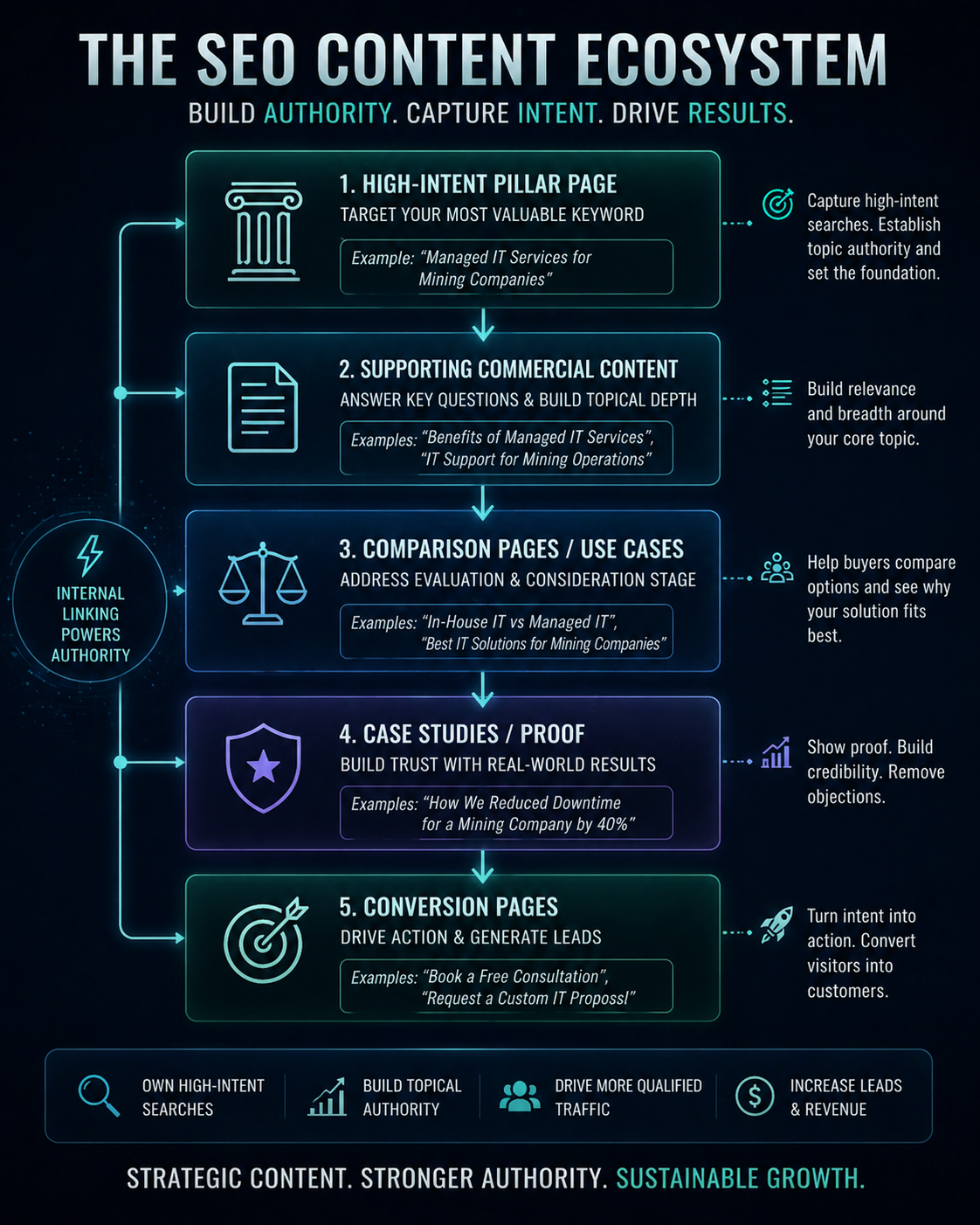
- High-Intent Pillar Page
- Supporting Commercial Content
- Comparison Pages / Use Cases
- Case Studies / Proof
- Conversion Pages
Every piece has a role: capture intent, build trust, drive action.
Why most SEO strategies fail
They:
- Prioritise traffic over revenue
- Ignore search intent
- Create disconnected content
- Don't align with sales conversations
The result: rankings without pipeline, traffic without deals, effort without ROI.
What control actually looks like
When done properly:
- You rank for decision-stage keywords
- Your brand appears in high-value searches
- You generate inbound leads consistently
- You reduce reliance on paid spend over time
- You build a defensible acquisition channel
This is not marketing activity. This is market positioning inside search.
The takeaway
SEO isn't about content. It's about:
- Owning high-intent moments
- Aligning with how buyers actually search
- Building a system that compounds
Paid ads get you in the game faster. SEO ensures you stay there.
Final thought
The businesses that win are not the ones with the most traffic. They are the ones who show up when the buyer is ready, with the right message, at the exact moment of decision.
Because in modern marketing… Control doesn't come from visibility alone. It comes from owning intent.
Sources & References
- Google — Understanding Search Intent & Ranking Systems
- Google — How Search Works (Ranking & Intent Signals)
- HubSpot — SEO Strategy & Topic Clusters Explained
- Ahrefs — Keyword Intent & SEO Strategy Frameworks
- Semrush — High-Intent Keywords & Conversion Strategy
- McKinsey & Company — B2B Decision Journeys & Digital Buying Behaviour
- Think with Google — How People Research Before Buying
- Gartner — Complex B2B Buying Journeys & Intent Signals
This article is informed by industry research and frameworks from leading platforms including Google, HubSpot, Ahrefs, Semrush, McKinsey, and Gartner.